0%
of the variance in team engagement traces to one person: the manager. Not pay, not perks, not brand. The manager is the weather. Everything else is the furniture.
Gallup · decades of polling · millions of workers
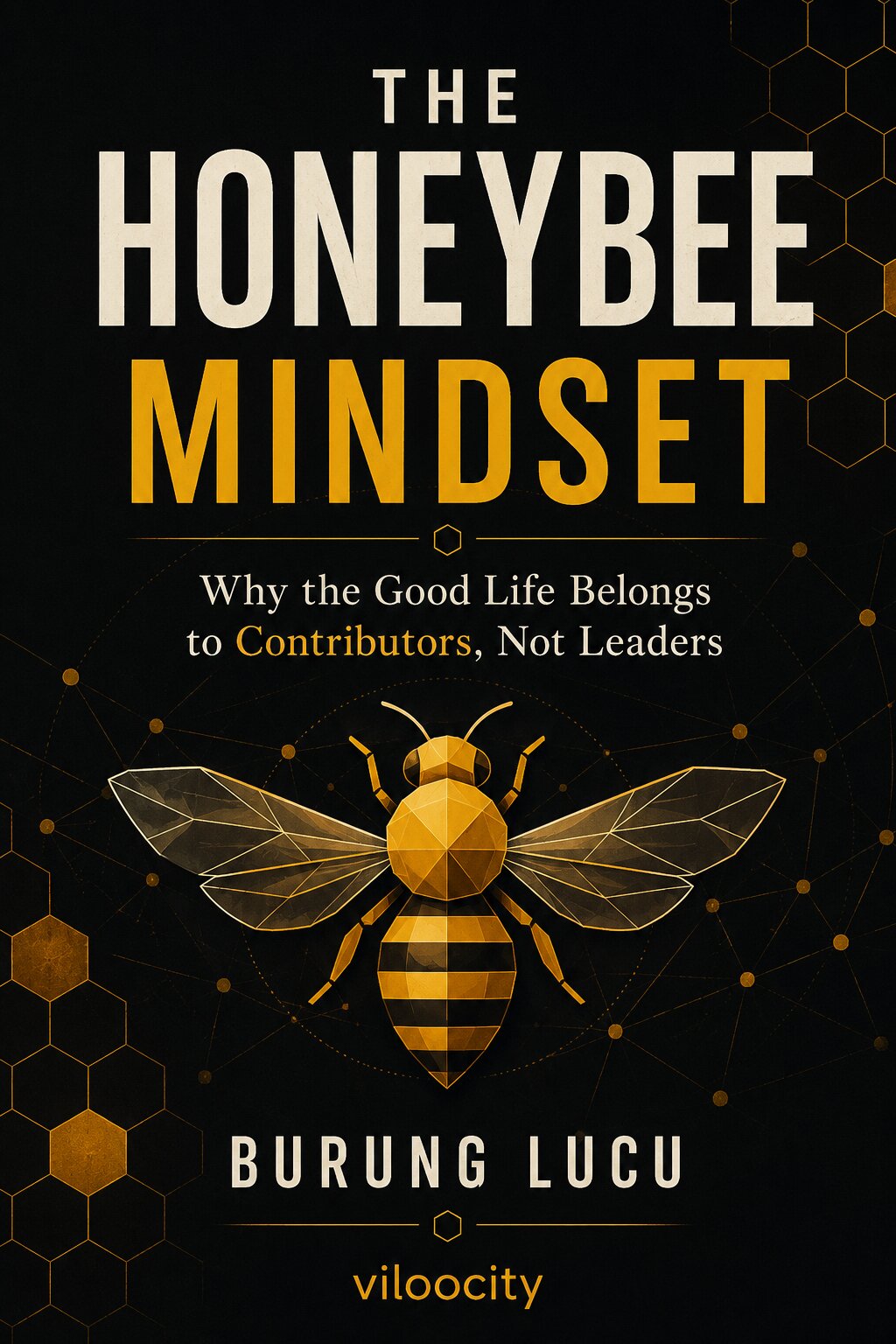
TheHoneybeeMindset
Why the good life belongs to contributors, not leaders
viloocity
The Honeybee Mindset · by Burung Lucu · viloocity · 2026
You can be a pollinator.
Society has confused visibility with value. The leader-centric model is overrated — and the evidence shows it often harms both leaders and communities. The honeybee offers a better model: purposeful contribution, local communication, distributed wisdom, and collective flourishing.
We built an entire economy — a culture, a self-help genre, a whole way of arranging a life — around the assumption that visibility and value are the same thing. They are not the same thing. The podium is a magnet, not a measure.
The visibility trap charges rent in four currencies:
"Worker bees do not wait for orders from the queen. They read local cues, communicate, and act. The queen is not a boss or a decision-maker."
This is not anti-work. It is anti-waste.
The harm is not rare, and it is not a few bad apples. It is measurable, ordinary, and structural — and it wounds the leaders too. Hold the evidence in hand before the book hands you the alternative.
"People over-attribute organizational outcomes to leaders. Leadership is often a convenient story, not an accurate explanation." — after Meindl, Ehrlich & Dukerich (1985)
0%
of the variance in team engagement traces to one person: the manager. Not pay, not perks, not brand. The manager is the weather. Everything else is the furniture.
Gallup · decades of polling · millions of workers
0%
of employees have, at some point, left a job to escape a manager. Not for money. Not for a better role. People do not leave jobs. People leave people.
Gallup · "roughly half" · repeated findings
People systematically over-attribute outcomes to the person at the top — the strategy, the timing, the culture, the luck. A convenient story about causality, not the mechanism.
Meindl, Ehrlich & Dukerich · 1985
Destructive leadership is reliably associated with stress, reduced well-being, lower job satisfaction, and counterproductive work behavior — across workplaces, industries, and countries.
Schyns & Schilling · 2013
Give people power — even at random, in a lab — and they grow less attentive to others, more impulsive, more perspective-blind. The podium changes the vision of whoever stands on it.
Keltner · Galinsky
Narcissistic CEOs make more volatile strategic bets — extreme acquisitions, transformations they cannot deliver — and are paid significantly more for it, without better performance.
Chatterjee & Hambrick · O'Reilly et al.
The leadership industry expanded enormously while the quality of leaders and the trust of followers did not. It sells the ladder — and the evidence says the ladder goes nowhere.
Kellerman · Pfeffer
What predicts a group's performance is not its brightest member but how members share attention and build on one another. Distributed competence beats the singular hero.
Woolley et al. · collective intelligence
A critique of structures, not persons — the good leaders are casualties too. The model sets them up to become the harm, or to break trying not to be it.
We import the wrong picture of the hive — a monarchy, a throne, one brain deciding for all — because that is the story our own culture tells about power. It is not how bees work.
A hive is not a kingdom. It is a crowd — a dense, humming, warm crowd of sisters, each one reading the world around her and acting on what she finds. No bee is waiting for a command. A forager reads the nectar: how rich, how far, in which direction. She does not report to a supervisor.
The queen issues no orders, makes no decisions, commands nothing. She does not choose the hive's new home or set its direction. The decisions — where to live, when to swarm, what to build — are made by the many, through a quorum, not by the one.
Scouts dance for the sites they found. Others fly out and verify. When enough independent witnesses agree, the quorum tips and the swarm moves. Every step of the way, the hive checks confidence against evidence — which is exactly what the podium fails to do.
"A honeybee swarm chooses its new home through distributed decision-making. Scouts dance, others inspect, and the swarm reaches a quorum. The queen does not command the choice."
Decision by quorum, not command. Scouts advertise, the crowd verifies, and when the quorum tips, the swarm moves. No one is in charge — and no single point of failure can chill the whole.
One idea and one practice per chapter — so you can begin living the hive before you finish the book.
Contribution over command — be useful without being important.
Chapter 4Share what you find — locally, honestly, without performing.
Chapter 5Small acts of craft that accumulate into something permanent.
Chapter 6Decide by quorum, not command — many small views beat one big one.
Chapter 7Leave every field you feed from richer than you found it.
Chapter 8Recover on purpose. The spring depends on the pause.
Chapter 9Contribute beside people, not above them.
Chapter 10Not the ladder. Not the podium. The hive.
Four territories, four chapters — taking the principles into the career, the team, the street, and the feed.
A fulfilling life as an individual contributor, without forcing yourself into management. Depth over altitude.
What a team looks like when competence, not hierarchy, coordinates the work — and no one has to be the weather.
What belonging looks like on a street, not a stage. Fix the hundred small things no one counts.
From personal brand to useful signal. Resist the visibility economy; be useful without performing.
The old ledger counts what the podium can see. The honeybee ledger counts what actually makes a life feel alive.
The bees do not have a leadership industry.
They have a hive, and the hive flourishes.
Here is the promise, and I mean it literally: you do not have to be the queen to live a good life. You can be a pollinator. You can be the worker bee who reads the world around her, who shares what she knows without commanding anyone, who does small acts of craft that accumulate into something permanent, who serves the flowers she feeds from, who rests in winter so the spring can come. You can be useful without being important. You can contribute beside people instead of above them.
This book will not tell you how to become a better leader. It will show you, with the evidence in hand, why you may not need to be one at all.
You are not a failed leader. You are a worker who was handed a ladder by mistake.
You have been standing under a podium, waiting to be called up. The hive is not waiting for anyone. It is already humming.
— 12 —
From the Introduction — The Leadership Trap · pp. 9–12
Take a piece of your week and make two lists — everything that served a metric, and everything that served a person or a craft. Honesty first, guilt never: the point is to see, with your own eyes, where your contribution actually went.
The follower count you checked. The post you wrote to be seen. The meeting you ran to look in charge. The status you chased.
0 items
The thing you fixed that no one saw. The help you gave without recording it. The hour spent getting better at the work itself.
0 items
—fed the hive
Add a few honest items from your week. The point is to see, not to judge.
Most people find, to their surprise, that the invisible list is where their real value lives. The hive runs on list two.
Seven lines that name the life you have been practicing all along.
Pollinate. Serve the flowers you feed from.
Dance. Share what you find — honestly, locally.
Build honeycomb. Let small acts of craft accumulate.
Swarm. Decide together — quorum, not command.
Serve. Leave every field richer than you found it.
Rest. Keep winter, so the spring can come.
Work beside, not above. Be a worker among workers.
You do not have to be the queen to live a good life.
You can be a pollinator.